
ULSS n.4 VENETO ORIENTALE
(2019-2020)
The project, aimed at healthcare personnel with coordination functions (middle management) of the ULSS n.4 VENETO ORIENTALE company, responded to the client's need to re-qualify their professionalism in the sense of "People", in a logic of construction and development of skills to help them better manage the present and its needs.
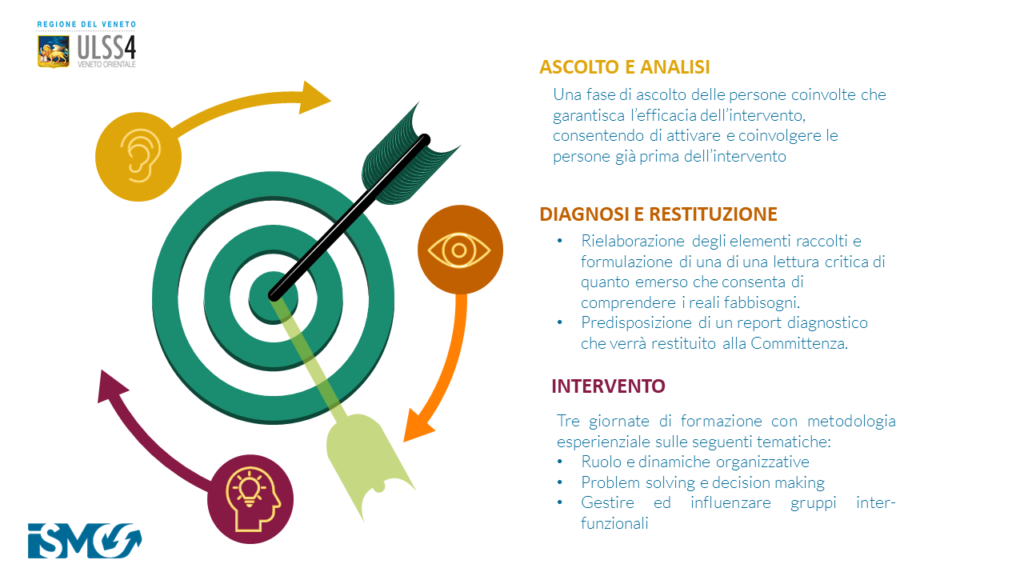
The course consisted of three days of training in which the themes of complexity, team working and people management were explored.
After a pre-work session necessary for the acquisition of the basic elements of the course, on the first day the participants discussed the meaning of their role, discovering not only its current functions but also its possible future perspectives. The premise of this approach was to make the recipients understand how each of them lived a 'complex system', i.e. immersed in a network of relationships in which to learn to move effectively. In order to do this, the participants, in addition to the classroom lessons, were engaged in workshop experiences, some of them in outdoor mode, where they could experience the possibility of "getting out" of their habits and consolidated practices, tracing new possible personal and professional paths.
The second day was devoted to problem solving oriented towards team working, i.e. the ability to influence and manage people beyond the hierarchy, knowing how to compose individualities in the pursuit of a common goal. The third day was devoted to an in-depth discussion on people management from a cross-functionalperspective.
Objectives achieved
The training enabled people to acquire five key competences:
- understanding how to work in complex and changing systems , knowing how to move 'fast' in decision-making
- acquire the ability to influence and manage people beyond the hierarchy, in increasingly cross-functional organisational models
- understanding one's own organisational role, which has changed over the years and is still in flux
- Re-reading one's own experience and relational skills for the application of new learning;
- acquiring skills to manage stress as well as conflict situations, always keeping an overview and the overall organisational goal.
Project value proposition
The use of an experiential methodology proved effective in allowing participants to step out of their comfort zone, facilitating self-understanding and teamwork. Working in groups also made it possible to disseminate best practices, giving participants the knowledge that they could more effectively interpret their own role by interpreting the role of others, in a systemic logic. Each participant was allowed to apply his or her own mental, cultural and behavioural patterns, while having the opportunity to review and rework them in the light of those of their colleagues.