
INPS
(2020-2021)
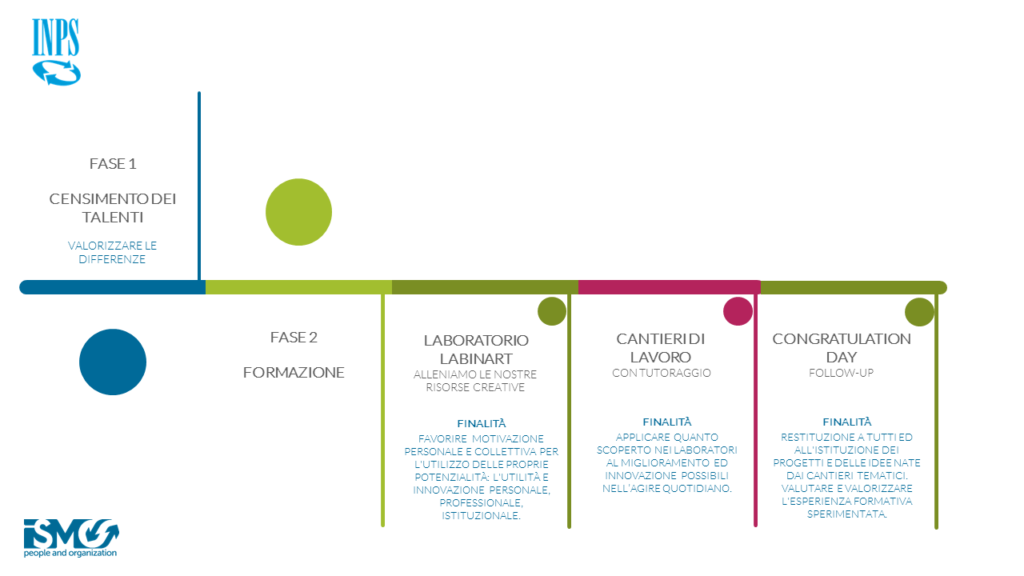
The training course started from the need to give a new impulse to the process of strong innovation that has been accompanying INPS internal policies for years, oriented towards improving the quality of the service offered to citizens. The recipients of the training were selected on the basis of a questionnaire previously shared with the INPS employee community, containing questions relating not only to their work, but also to their unexpressed competencies.
The project, in fact, was born from the idea of enhancing people's talents in a creative logic, with a specific focus on art, intended as a stimulus through which to develop one's own inclinations.
Through an experiential methodology, in which each participant was allowed to tell his or her own story, showing traits of self that only at first might seem distant from their professional role, participants had the opportunity to explore their own selves, discovering how to reconcile their inner world with their productivity objectives. In particular, using exercises inspired by the world of visual art (painting, architecture, design...), they rediscovered the sense of imagination and creativity as a resource and possibility, overcoming self-censorship and fear of error.
This was done through a series of transversally composed group works in which the potential of storytelling as a tool for transformation and sharing was explored.
Finally, the process ended with a project in which each group, feeling responsible for their organisation, decided to take action on certain internal issues to which they felt they could actively contribute.
Objectives achieved
The training enabled people to rediscover and enhance four dimensions:
- Competences related to innovation: overview, knowledge of the context and its evolutionary lines, interpreting internal and external needs, vision of opportunities, complex and systemic thinking, error management, open mindedness and forward thinking.
- Competences related to problem solving and decision making: searching for information, measuring and giving indicators, finding solutions and monitoring their outcomes, analytical and flexible thinking, synthesising analysis and setting goals, defining action strategies, dealing with uncertainty.
- Relational skills: influencing and generating positive climates, integrating sensitivities and experiences, managing conflicts, motivating for results.
- Developing project management skills: from understanding objectives, to organising work to achieve results, to pursuing institutional goals with others; using teamwork and project management tools.
Project value proposition
Techniques and devices have been designed taking into account the opportunities given by technologies but especially the way in which digital technology shapes ways of thinking and working: speed, connection, flexibility, accessibility, personalisation. Competence can be acted upon by trying to bring one's own resources into play in relation to the context as perceived and understood. Participants thus assimilated that competence is not only a "doing", but also requires an "acting": that is, it requires the person to take part in the action with all his/her resources, as well as with those of others with whom one relates.