MARCHE REGION
(2020-2021)
The project "Managerial training - Management and personal development", addressed to the community of managers of the Marche Region, responded to the need expressed by the Authority to implement a profound organisational transformation, oriented towards a more agile management of processes, in compliance with the "Organisational Plan for Agile Work" (POLA).
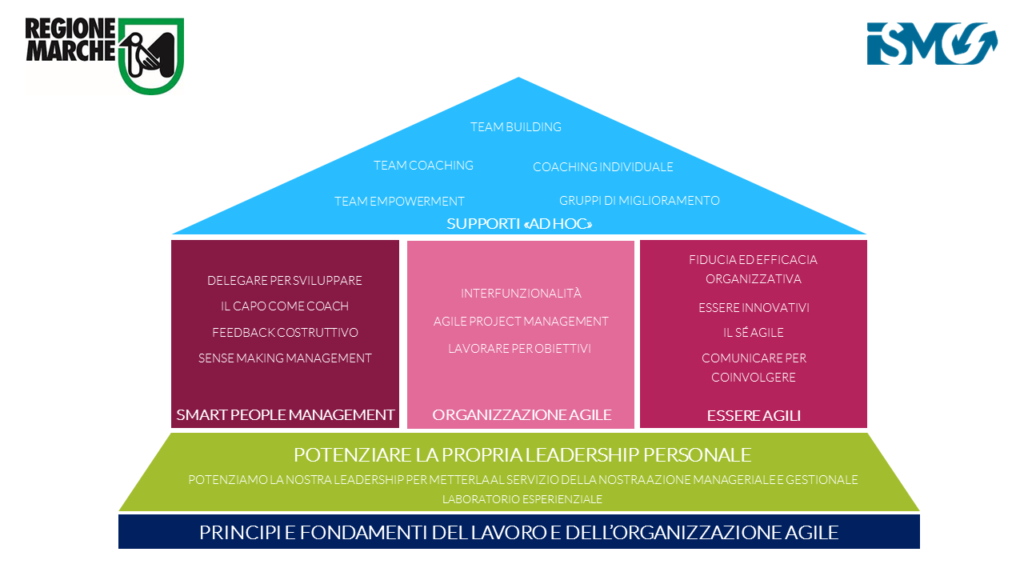
The group of managers (70 people), divided into two focus groups, were accompanied to critically re-read their own role as well as their own professional environment, in order to acquire those transversal competences necessary for the passage from a technical leadership, based on a mainly hierarchical and bureaucratic culture, to an attractive-generative leadership, to be earned on the field with one's own actions.
For this reason, a didactic environment of continuous experimentation was built where people could concretely, in a workshop context, carry out the actions they intended to translate into their working practice, feeling encouraged to dare, in the knowledge that change was not only possible, but also capable of generating the desired effects.
Managers, accompanied by ad hoc diagnostic tools, all felt the need to review their approach, discovering that there is no continuity between individual processes and the people who work in those processes. The importance of putting the "person at the centre" therefore emerged, favouring the involvement, trust and participation of all.
At the end of the process, each manager had the opportunity to draw up his or her own agile change project to be implemented in the organisational structure for which he or she is responsible.
Objectives achieved
The objectives of the project, in line with the needs of the Marche Region and the methodologies used, were defined by the participants themselves, who, through the use of special diagnostic tools provided in the workshop experiences, were able to identify the salient points of organisational change. The first objective was to produce quality professional relationships, through which teamwork and overview could be enhanced. Secondly, the learners understood how to use their individual and group leadership to virtuously influence their organisational environment. Thirdly, the participants learned a series of tools (methodological and diagnostic) to add to their "toolbox".
Project value proposition
The training course was not constructed in an academic-formal manner, but in an experiential logic, making ample use, in addition to classroom moments, of laboratory practice. A didactic environment of continuous experimentation was therefore created, where participants could immediately put into practice the notions they had learnt, acquiring the awareness of how each of their actions could correspond to a determined change in the context in which they were operating. In addition, the focus group methodology meant that not only did the managers deepen their personal knowledge, but they also learned to work together, making collaboration their operational-decision-making criterion.