
SERGE LATOUCHE 19 March 2014 | LavorInCorso - Candide 2012 and beyond
"How can we build a sustainable society?
Is the voluntary choice of a degrowth society a gamble worth attempting to avoid a brutal and dramatic backlash?
The term 'degrowth' sounds like a gamble or a provocation, despite the general awareness of the incompatibility of infinite growth on a planet with limited resources, we therefore need a radical change.
What other social logics should we invent?"
Against universalism, Latouche instead claims the need to "enhance the aspiration for a dialogue between cultures, for a coexistence of cultures. For this reason, he opposes to the perspective of universalism a "plural universalism," which consists in the recognition and coexistence of diversity, and in the dialogue between these diversities."
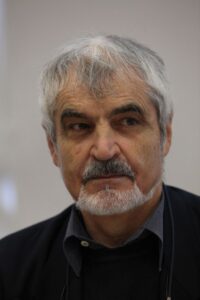
SERGE LATOUCHE - (Vannes, 12 January 1940) is a French economist and philosopher. He is one of the driving forces behind La Revuedu MAUSS and is president of the association "La ligne d'horizon". He is Professor Emeritus of Economic Sciences at the University of Paris XI and at the Institut d'études d'étudesdudeppementéconomique et social (IEDS) in Paris. He is one of the best known opponents of the westernisation of the planet and an advocate of convivial degrowth and localism. Known for his work in economic anthropology, Serge Latouche criticises the concept of economics in its formal sense, i.e. as a mere choice between scarce means to achieve an end. Referring in this sense to the thought of Karl Polanyi, he aims to propose in his works the concept of the economic, referring to the definition of substantial economy, understood as an activity capable of providing the material means to satisfy people's needs. He criticises, through theoretical arguments and with an empirical approach including numerous examples, the concept of development and the notions of rationality and economic efficiency. An enemy of consumerism and instrumental rationality, Latouche is an intellectual with very personal traits who was introduced into the Italian debate by publishing houses and cultural groups of the radical left. Latouche is one of the most acute critics of the universalist ideology with utilitarian connotations. Referring to the concepts of Marcel Mauss and Ivan Illich, he calls for the liberation of Western society from the universal economic dimension. Those in the contemporary world who question the universalist perspective, i.e. Western civilisation's claim to impose on the whole world a set of values considered valid for the whole human race, are objected to the fact that criticising universalism can lead to relativism and particularism. Has not particularism, understood as the exaltation of particular cultures, often generated divisions and struggles in the name of a narrow, selfish vision of one's own identity?
Latouche overturns this accusation, placing it on universalism, which is nothing more than a Western ideological creation, of a West that in the name of its own identity, the identity of the Western tribe, as Rino Genovese says, claims to impose a cultural imperialism on the rest of the world.
Essential bibliography Creative thinking against the economy of the absurd, Bologna, EMI, 2002. Obiettivo decrescita, with others, Bologna, EMI, 2004. How to survive development. Dalla decolonizzazione dell'immaginario economico alla costruzione di una società alternativa, Torino, Bollati Boringhieri, 2005. L'invenzione dell'economia, Torino, Bollati Boringhieri, 2010 La scommessa della decrescita, Milano, Feltrinelli, 2007. Breve trattato sulla decrescita serena, Torino, Bollati Boringhieri, 2008. La sfida della decrescita. Il sistema economico sotto inchiesta, with Riccardo Petrella and Enrique Dussel, Città di Castello, L'Altrapagina, 2008. Mondializzazione e decrescita. The African alternative, Bari, Dedalo, 2009. Come si esce dalla società dei consumi. Courses and paths of degrowth, Turin, Bollati Boringhieri, 2011. Il tempo della decrescita. Introduction to happy frugality, Milan, Eleuthera, 2011. Per un'abbondanza frugale. Malintesi e controversie sulla decrescita, Torino, Bollati Boringhieri, 2012. Will there still be life after development?, in Roberto Colonna (ed.), Latin America and the West, Salerno, Arcoiris, 2012, pp. 159-174