
by Claudio Funes
Yes, you read that correctly: conflict FOR well-being.
Conflict within organizations is often perceived as an obstacle to well-being and productivity. I remember a client telling me years ago to change the title of the material used for a course from "Conflict management" to "Advanced negotiation." I asked him why. His answer was laconic: "You know, there is no conflict in this company, and if managers read this title, they might take offense." But what if we told ourselves that conflict, when allowed and dealt with competently, can become one of the most powerful tools for creating creative, innovative organizations that are capable of evolving and resilient?
The reality of organizational conflict
Recent data paints an alarming picture: US employers are losing as much as $3,216.63 per employee per year in productivity due to poorly managed conflicts. An organization with 500 employees loses an average of over $1.6 million annually. However, 95% of participants in conflict resolution training programs experience a noticeable improvement in the workplace, demonstrating that investing in constructive conflict management yields tangible results. These figures come from a study conductedby CPP Inc., the publisher of the Myers-Briggs Type Indicator and the Thomas-Kilmann Conflict Mode Instrument in 2023. The study analyzed the impact of conflict in the workplace in the United States and found that:
- The average employee spends approximately2.8 hours per weekmanaging conflicts.
- This translates to an estimated lossof $359 billion inpaid hours nationwide.
- The average cost per employee was calculated at approximately$3,216.63 per year, as you mentioned.
- In addition,95% of participants inconflict resolution training programs reported a higher level of perceived well-being in the workplace.
Academic research confirms this dichotomy: conflict can, in fact, be positive if managed correctly. Conflict can promote team-building skills, critical thinking, new ideas, and alternative solutions.
Not all conflicts are the same. Organizational literature mainly distinguishes between task conflict and relationship conflict.
Task conflict can be constructive when it brings diversity of thought, preventing us from becoming trapped in cycles of overconfidence. It can help us remain humble, raise doubts, and make us curious about what we might be missing. On the contrary, relationship conflicttends to negatively impact performance as it can increase hostility among group members, reduce collaboration, and distract attention from the task.
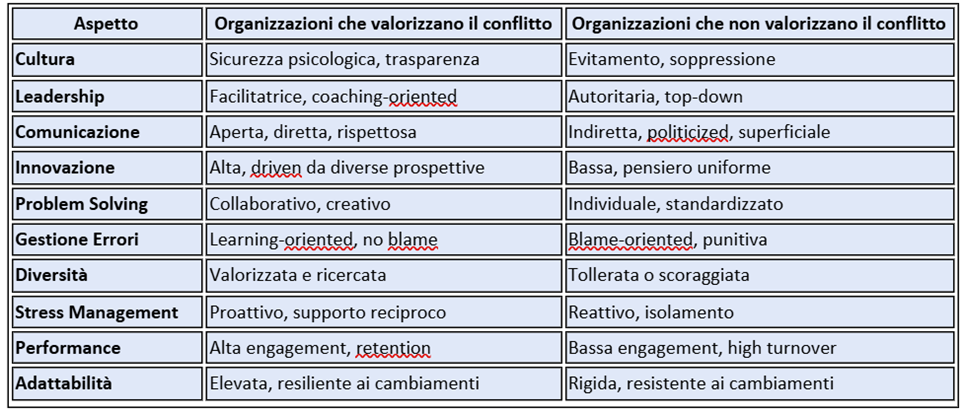
Organizations that use conflict in a generative way have certain distinctive characteristics:
- psychological safety: they create environments where employees feel safe to express dissent and different opinions;
- facilitating leadership: leaders act as facilitators of constructive dialogue, not as arbitrators;
- focus on processes: clearly distinguish between conflicts over processes/tasks and personal conflicts
- continuous learning: they see every conflict as an opportunity to improve and innovate
- reversibility of thought: they actively value and seek out different perspectives
On the contrary, organizations that manage conflict poorly show:
- systematic avoidance: tendency to shut down or ignore disagreements;
- personalization: conflicts of ideas quickly degenerate into personal attacks;
- rigid hierarchy: decisions are imposed from above without dialogue or participation;
- culture of blame and scapegoating: focus on finding the culprit rather than solutions;
- forced conformity: social pressure toward uniformity of thought.
The myth of harmony
Remember the Mulino Bianco commercials from the 1990s? The happy family, all beautiful and with dreams to pursue? Well, the greatest risk of self-deception that I see today, in organizations and in some of the underlying objectives of change and training initiatives, is the pursuit of the myth of harmony at all costs. The conflict-free organization, in which conflict is removed (the problem will be solved when it no longer exists) by an authoritarian-paternalistic style of relationship management, is suffocated, by a suffocating maternal style, evaporated, by a laissez-faire, laissez-passer style.
The paradox of well-being through conflict
Teams with high levels of cohesion can even benefit from team conflict when it arises. Therefore, conflict can be an opportunity for growth rather than something to be avoided, stifled, or ignored.
This leads us to a counterintuitive conclusion: true organizational well-being does not come from the absence of conflict, but from the ability to transform it, to negotiate it. In this way, conflict calls us to action and asks us to activate some of our internal resources and focus on specific tasks to explore parts of ourselves that are hidden (from others and even from ourselves!) and to stimulate interpersonal relationships that encourage the expression of interests rather than entrenchment in specious positions, which results in blocking communication or its toxic opposite: escalation.
Generative conflict encourages team members to discuss issues transparently, address misunderstandings, use specific conflict communication skills, and develop trust.
(Some) practical recommendationsfor transforming conflict from an obstacle into a resource:
- invest in training: develop conflict management skills at all levels;
- create rituals of dissent: implement structured practices for expressing different opinions. "Agree to disagree," as an old Intel adage from the 1980s said;
- measuring "healthy conflict": introducing metrics that value diversity of thought;
- Leadership Role modeling: Leaders must be the first to demonstrate vulnerability and openness to feedback.
The future of high-performance organizations lies in their ability to embrace conflict as a catalyst for growth. It is not a question of creating conflictual environments, but of building systems capable of metabolizing creative tensions in a generative way. What do you think?
#OrganizationalDevelopment #ConflictManagement #Leadership #Wellbeing #Innovation #TeamDynamics